
Airless Pump vs Dropper Bottle: Why Vitamin C Packaging Decides Shelf Life
Packaging is the part of a vitamin C serum people compare least and that affects the result most. What each format does to the active, and what to look for on the shelf.
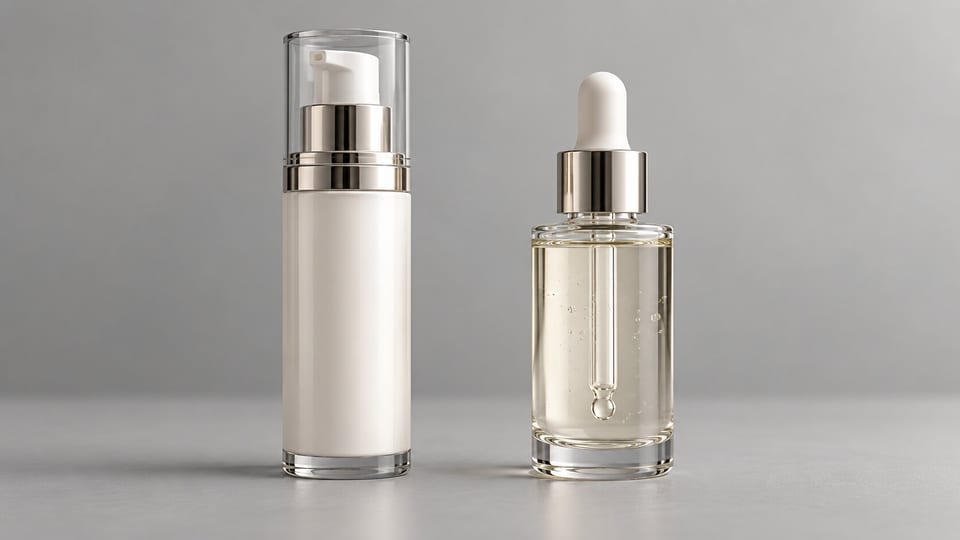
Two serums with identical ingredient lists can perform differently for one unglamorous reason: one of them keeps air and light away from the formula and the other does not.
The three things packaging has to block
Oxygen, light and heat all degrade vitamin C. Packaging can do a lot about the first two.
Airless pump
A piston follows the product up as it empties, so the formula is never sitting in a headspace of air. Each press dispenses without letting air back in. For L-ascorbic acid, this is the most protective mainstream format.
Downsides: you cannot see how much is left, a small amount can be stranded at the end, and a failed pump mechanism ruins the bottle. It is still the format to prefer for an unstable active.
Dropper bottle
The familiar glass pipette. Every use opens the bottle, draws air in, and leaves a growing air gap above the liquid as it empties. The dropper itself often rests in the neck, part-open, between uses.
Where it is acceptable: with a stable derivative, in amber or opaque glass, in a small bottle you will finish quickly. Where it is a poor match: high-percentage L-ascorbic acid in a large clear bottle — the combination most likely to go orange before you reach the bottom.
Tube, and the rest
An opaque squeeze tube with a narrow nozzle is a reasonable middle option: little light, limited air exchange, no mechanism to fail. Jars are the worst case for vitamin C — wide open to air, and fingers going in each time.
How the formats compare
| Format | Air exposure | Light protection | Best for |
|---|---|---|---|
| Airless pump, opaque | Very low | High | L-ascorbic acid |
| Opaque tube | Low | High | Either |
| Amber dropper | Moderate | Moderate | Stable derivatives |
| Clear dropper | Moderate | Low | Short-course use only |
| Open jar | High | Varies | Not vitamin C |
What to check before buying
- Is the container opaque or deeply tinted? Clear glass with a bright formula inside is a bad sign for L-ascorbic acid.
- Does it dispense without opening? Pump or nozzle beats pipette.
- Is the size realistic? Match it to the period-after-opening window — see storage and shelf life.
- Does the form match the packaging? A stable derivative in a dropper is a coherent choice. Pure L-ascorbic acid in a clear dropper is a compromise, whatever the percentage says.
We record packaging format for every product, so you can weigh it alongside form and concentration on all serums, or in our India picks. How we weigh these factors is set out in our ranking methodology.
Does it matter more than concentration?
Often, yes. A well-packaged 10% serum that is still active at the end of the bottle beats a 20% one in clear glass that has turned orange by week six. Packaging is not a detail — it is what decides whether the percentage on the label is still true when you use it.
Common questions
Is an airless pump better for vitamin C serum?
For L-ascorbic acid, yes. The piston follows the product up as it empties so the formula never sits in a pocket of air, which makes it the most protective mainstream format.
Are dropper bottles bad for vitamin C?
They are a poor match for high-percentage L-ascorbic acid in clear glass, because every use lets air in. A stable derivative in a small amber dropper bottle is a coherent choice.
Does an amber or opaque bottle really matter?
Yes. Light is one of the three things that degrade vitamin C, alongside heat and oxygen, and clear glass on a bright shelf offers no protection at all.
Can good storage make up for bad packaging?
Only partly. Storage habits cannot stop air entering the bottle every time you use it, so packaging is worth weighing before you buy rather than after.
Compare vitamin C serums sold in India → or browse ingredient explainers and picks by skin type and budget.
More from the blog
- How to Read the Efficacy Claims on a Vitamin C SerumGuide · 2 min read
- Vitamin C Serum Concentration: Is 10%, 15% or 20% Right for You?Guide · 3 min read
- Why Vitamin C Serums Are Starting to Add Carnosine and Other Anti-Glycation ActivesIngredients · 3 min read
- Nine Vitamin C Serum Myths Worth DroppingMyths · 3 min read
We are not dermatologists. This content is for informational purposes only — consult a qualified professional for medical advice. See our editorial policy and medical disclaimer.